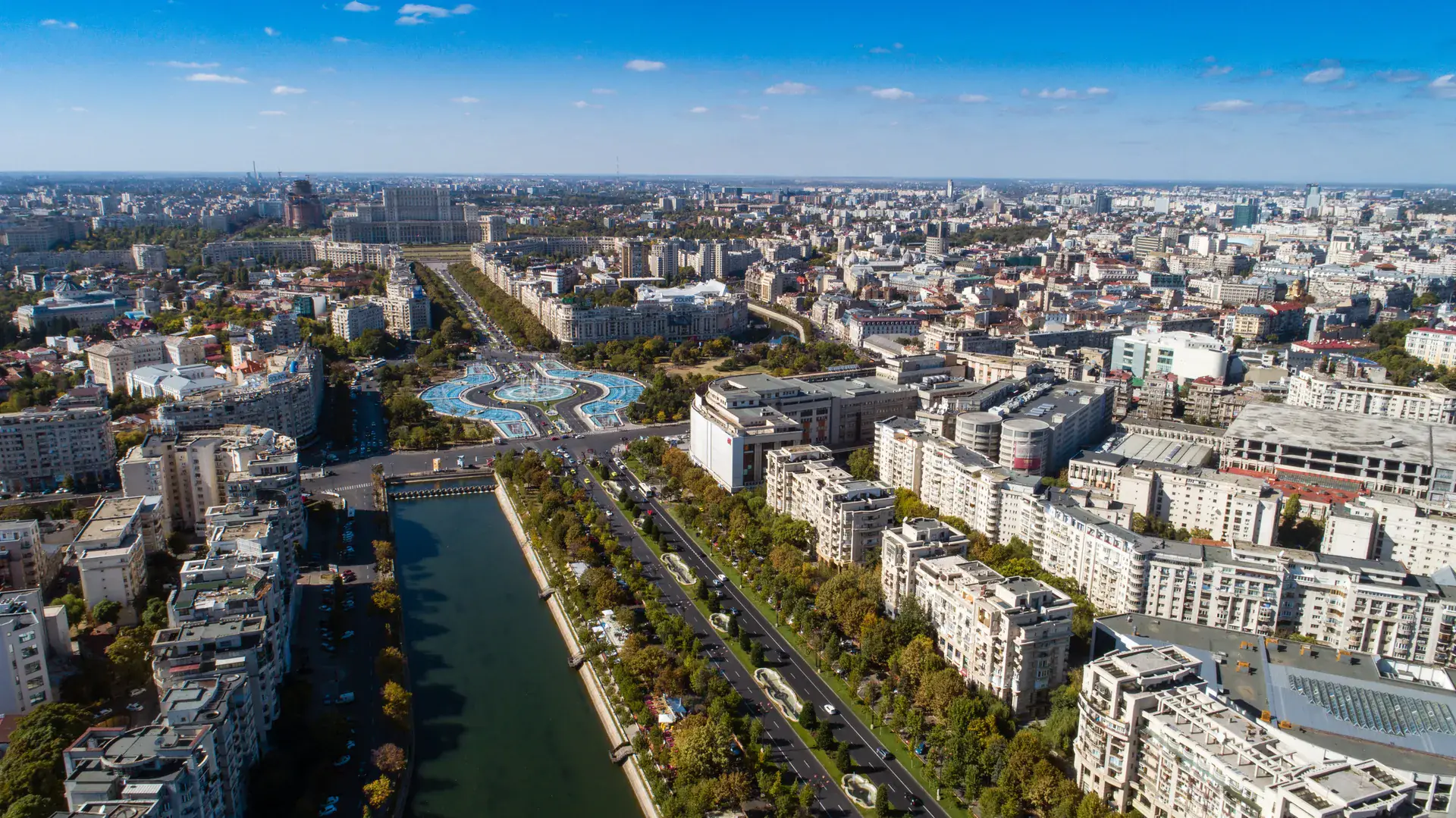
Bucharest
About
Discover the history of Bucharest
Bucharest was once called the little Paris of the East, and the wide boulevards, the Belle Époque villas and the white stone Arcul de Triumf are still there. Next to them stands the communist era's answer, the Palace of Parliament, a building of around a thousand rooms and one of the heaviest on earth. Music matters here: the Romanian Athenaeum, round and gilded, has hosted the national orchestra for more than a century. The old town fills every evening with terraces, wine cellars and bars open until dawn, at prices that still surprise people. The food is generous — grilled minced-meat rolls, sour soups, polenta with cheese and soured cream. North of the centre, Therme Bucharest gathers pools, slides and thousands of palm trees under vast glass domes. And the Carpathians begin two hours away, with the fairy-tale woodwork of Peleș Castle and the trails of Bucegi Natural Park.
Travel score
The travel score throughout the year.
January
Very badFebruary
Very badMarch
Very badApril
PoorMay
ModerateJune
Very goodJuly
Very goodAugust
Very goodSeptember
Very goodOctober
PoorNovember
Very badDecember
Very badThings to do
Discover the best attractions in Bucharest and its surroundings
Peleș Castle
Summer residence of the Romanian kings, completed in 1883, this neo-Renaissance palace in Sinaia was the first fully electrified castle in Europe. Trains from Gara de Nord take about two hours, followed by a fifteen-minute walk uphill from central Sinaia.
Bucegi Natural Park
The Bucegi plateau rises above 2,500 metres and holds the Sphinx and the Babele, rock formations carved by the wind. The cable car from Bușteni saves 1,300 metres of climbing, but it shuts down in high wind.
Cărturești Carusel
A bookshop opened in 2015 in a nineteenth-century building on Strada Lipscani, once the Chrissoveloni family bank, left derelict under communism and later restored: six white levels around an atrium and its stairways. Entry is free, and the top-floor bistro sits under the skylight.
Romanian Athenaeum
An 1888 concert hall paid for by public subscription, crowned by a dome and wrapped in a 75-metre circular fresco of Romanian history. It is home to the George Enescu Philharmonic, and a concert ticket remains the surest way to see inside.
Arcul de Triumf
A granite arch raised in 1936 to mark Romania's 1918 victory, with battle names carved across its faces. The rooftop terrace opens only a few days a year, usually around National Day on 1 December.
Mogoșoaia Palace
Built in 1702 by Constantin Brâncoveanu, this lakeside palace is the manifesto of the Brâncovenesc style, mixing Venetian loggias with Ottoman carving. It lies some twenty kilometres north-west of the city, reached by bus 460 from Laromet.
Other destinations you might like
Nearby picks in the same theme
Some of the text on this page is generated using AI and may contain inaccuracies. Please check important details.Photos and ratings provided by Google Maps