San Francisco
About
Discover the history of San Francisco
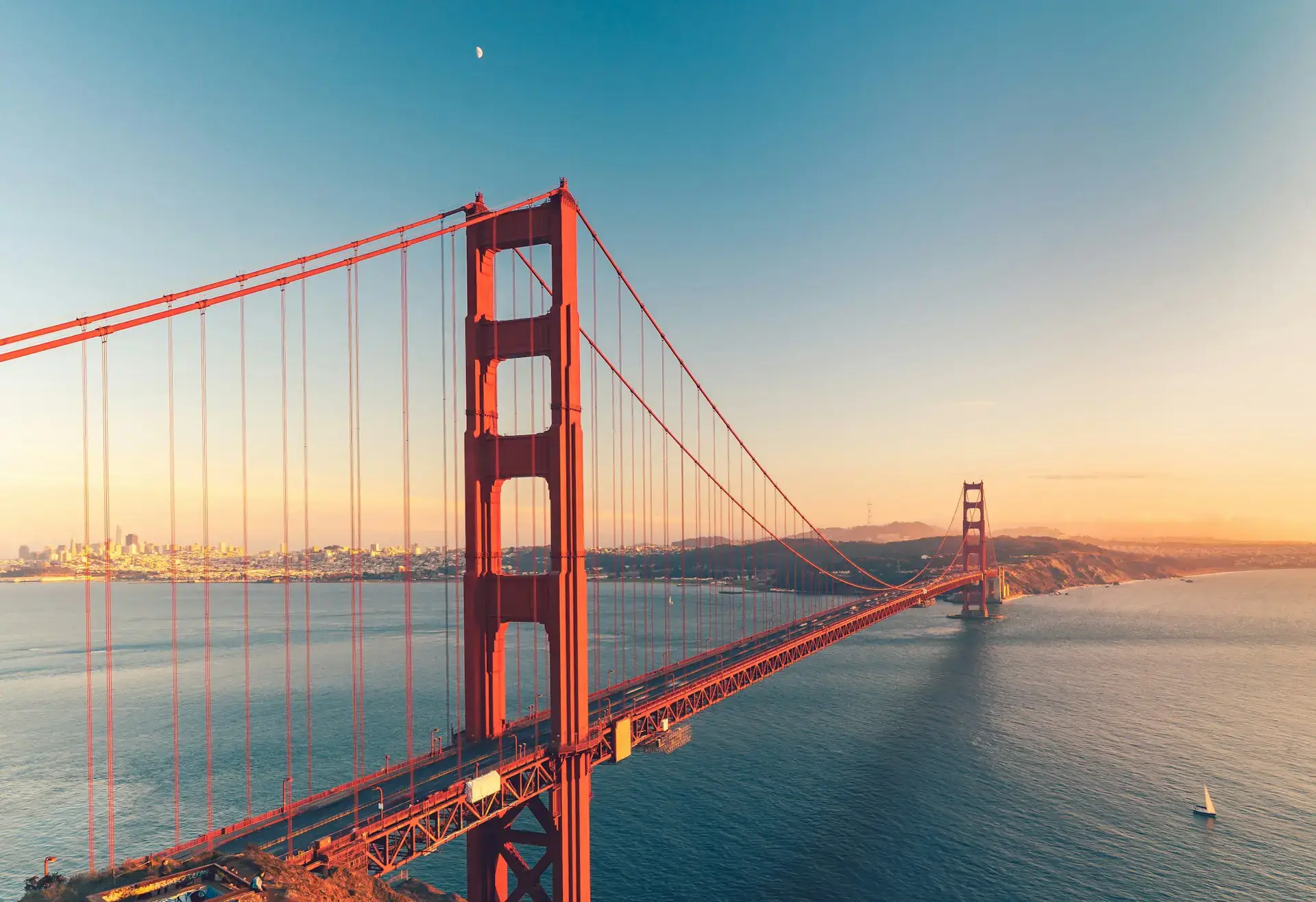
San Francisco is built on hills so steep that some streets turn into staircases. Cable cars have been climbing them since 1873, gripping a moving cable under the roadway, and the Cable Car Museum shows the wheels that still pull it. The Golden Gate Bridge carries its burnt orange span above the strait, tended all year round by a crew of painters, and riding across it is one of the city's great pleasures. Out in the bay, Alcatraz Island keeps the concrete cells of its old federal prison on a rock the currents cut off from the shore. Sea lions took over the docks at Pier 39 and never gave them back. Crab and sourdough are eaten by the water, and the city's restaurants cover half the planet. Golden Gate Park lays out four hundred hectares of lawns, gardens and museums. North of the bridge, the redwoods of Muir Woods National Monument rise more than seventy metres.
Travel score
The travel score throughout the year.
January
GoodFebruary
Very goodMarch
GoodApril
Very goodMay
Very goodJune
ExcellentJuly
ExcellentAugust
ExcellentSeptember
ExcellentOctober
ExcellentNovember
Very goodDecember
ModerateThings to do
Discover the best attractions in San Francisco and its surroundings
Golden Gate Bridge
Opened in 1937, the suspension bridge is painted a custom shade called international orange, chosen to keep it visible to ships in the strait. The east sidewalk is reserved for pedestrians, the west for cyclists; walking across is free.
Pier 39
A shopping and dining pier at Fisherman's Wharf, best known for the wild sea lions that took over the K-Dock floats after the 1989 earthquake and never left. Access is free, and the historic F-line streetcar stops at the entrance.
Golden Gate Park
A city park more than four kilometres long, laid out from 1870 across sand dunes and larger than Central Park, holding the de Young museum, the Academy of Sciences, the Japanese Tea Garden and a botanical garden. Part of JFK Drive is closed to cars and given over to cyclists and skaters.
Alcatraz Island
A federal penitentiary from 1934 to 1963, the island was then occupied for nineteen months by Native American activists whose painted slogans are still legible on the buildings. Ferries leave from Pier 33 and sell out weeks ahead; the audio tour is included.
Palace of Fine Arts
A neoclassical rotunda built in plaster for the 1915 world's fair, so well loved that it was rebuilt in concrete in the 1960s rather than torn down. The lagoon and colonnades photograph best early in the morning, before the tour groups.
Muir Woods National Monument
A valley of coast redwoods protected since 1908, where the oldest trees pass 1,000 years of age and 75 metres in height. Arriving by car or shuttle requires a reservation booked in advance — no parking is sold on site.
Some of the text on this page is generated using AI and may contain inaccuracies. Please check important details.Photos and ratings provided by Google Maps