Luxor
Om
Oppdag historien til Luxor
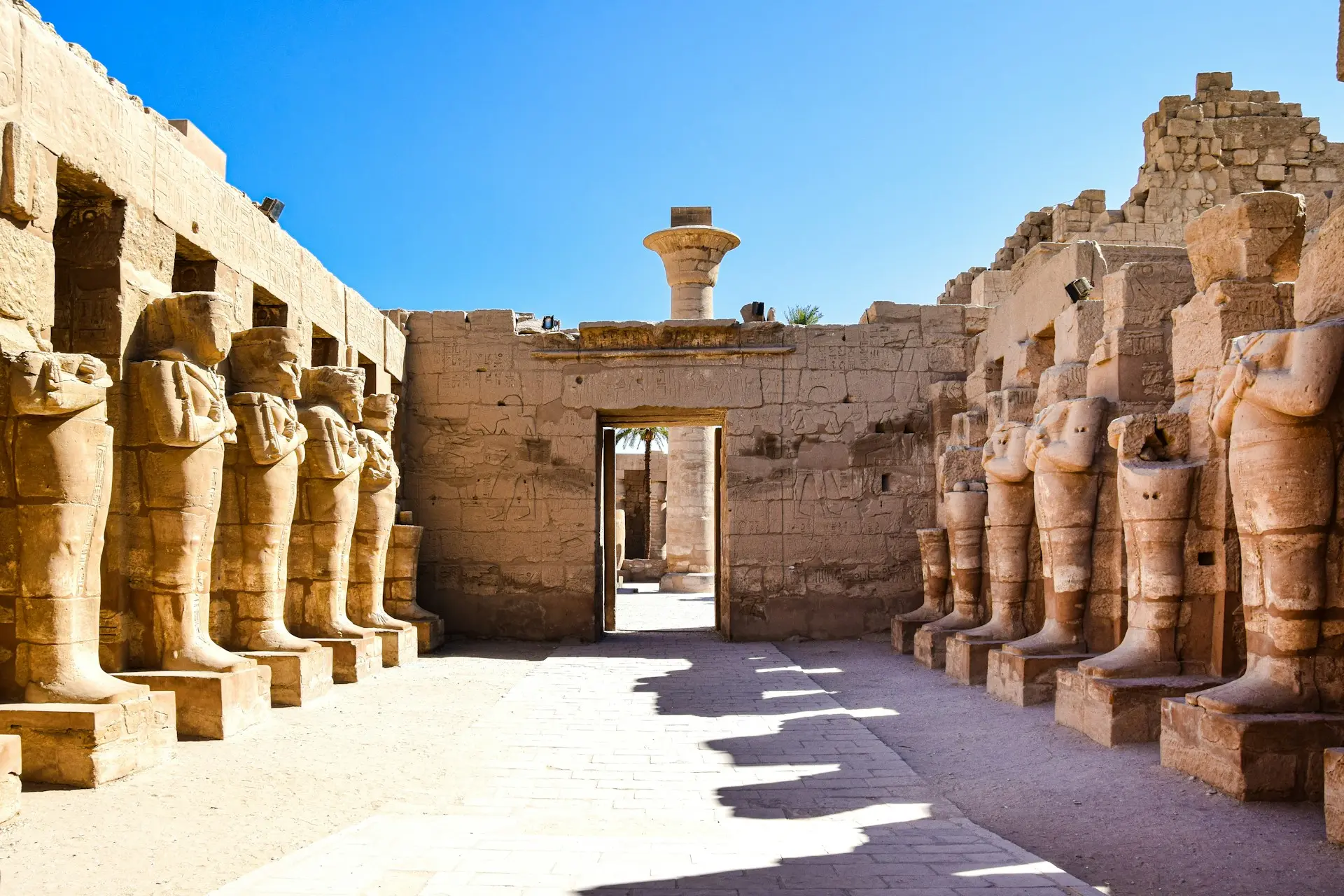
Luxor is built on Thebes, the capital of pharaonic Egypt, and the whole town amounts to an open excavation. Karnak Temple is the largest religious complex ever raised: its hypostyle hall holds a hundred and thirty-four columns as tall as buildings. In the middle of town, Luxor Temple is floodlit after dark, and an avenue of sphinxes almost three kilometres long once joined the two sanctuaries. Across the river, the Valley of the Kings hides some sixty tombs cut into the rock, Tutankhamun's among them, their painted walls still holding their colour. The Mortuary Temple of Hatshepsut rises against the cliff in three terraces facing the desert. The Luxor Museum shows, in low light, the statues lifted from a cache buried under the temple floor. The Nile runs between the two banks, edged with green fields and palms, and feluccas sail up against the current.
Reisescore
Reisescoren gjennom hele året.
Januar
UgunstigFebruar
ModeratMars
UtmerketApril
Veldig braMai
ModeratJuni
Meget dårligJuli
Meget dårligAugust
Meget dårligSeptember
UgunstigOktober
UtmerketNovember
UtmerketDesember
BraAktiviteter
Oppdag de beste attraksjonene i Luxor og omegn
Luxor Temple
Built by Amenhotep III and completed by Ramesses II in the centre of modern Luxor, keeping one of its two pylon obelisks — the other stands on Place de la Concorde in Paris — with the Abu el-Haggag mosque lodged in its first court. It stays open after dark, under floodlighting.
Karnak Temple
The largest religious complex of ancient Egypt, extended by pharaohs for nearly two thousand years; the hypostyle hall alone holds 134 columns, the tallest over twenty metres. The restored avenue of sphinxes can now be walked all the way to Luxor Temple.
Valley of the Kings
The burial ground of New Kingdom pharaohs, 63 tombs cut into a desert valley, Tutankhamun's among them. The standard ticket opens three tombs of your choice among those on rotation; Tutankhamun's and a few others cost extra, and photo permits are sold separately.
Mortuary Temple of Hatshepsut
The terraced mortuary temple of the female pharaoh Hatshepsut: three colonnaded levels built against the cliff face at Deir el-Bahari, on the west bank. From the ticket office, a small electric train shuttles visitors up the causeway to the first ramp.
Temple of Edfu
The best-preserved temple in Egypt, dedicated to the falcon god Horus and built under the Ptolemies between 237 and 57 BC, its walls still carrying complete ritual scenes. It stands 110 kilometres south of Luxor, a standard stop for Nile cruises between Luxor and Aswan.
Colossi of Memnon
Two 18-metre quartzite statues of Amenhotep III, all that remains standing of his mortuary temple. After an earthquake in 27 BC the northern colossus 'sang' at dawn, drawing Greek and Roman travellers whose graffiti survive; the roadside site is free at any hour.
Andre destinasjoner du kanskje liker
Forslag i nærheten i samme tema
Noe av teksten på denne siden er laget med KI og kan inneholde feil. Sjekk viktige opplysninger.Bilder og vurderinger fra Google Maps